- Published on
Forward and Reverse KL Divergence
- Authors

- Name
- Jonas Vetterle
- @jvetterle
I recently read this awesome blog post[3] about SFT, RL and On-Policy Distillation. It really brought to life to me how these methods differ in terms of (1) where the training signal is coming from and (2) the strength and nature of parameter updates. The article offers different explanations for why SFT is much more prone to catastrophic forgetting than RL and I recommend reading it for that alone.
One of the explanations has to do with the fact that the loss in SFT is using forward KL divergence, while the loss in RL is using backward KL divergence. Turns out this is not actually the author's favourite explanation, and recent experiments[2] showed that a better explanation might be the use of on-policy data. But I noticed that I never really thought about how the choice of forward and reverse KL divergence might affect training dynamics in principle. So that's the main focus of this article.
We're going to look at the following post-training methods:
- Supervised Fine Tuning (SFT): take starting distribution and make it similar to target distribution using negative log likelihood (NLL)
- Reinforcement Learning (RL), with 2 flavours: Reinforcement Learning with Verifiable Rewards (RLVR) and Reinforcement Learning from Human Feedback (RLHF). There is no target distribution. sample from starting distribution and score by reward function.
- On-Policy Distillation (OPD): sample from starting distribution like in RL, but score using target distribution like SFT or teacher model
tldr: the fact that SFT minimises forward KL divergence forces a model to match the target distribution regardless of its starting distribution. This gives rise to its mode covering behaviour and potentially bigger risk of catastrophic forgetting. RL/OPD on the other hand often (depending on the exact loss function) minimise reverse KL divergence, which leads to mode seeking behaviour. The model is not forced to cover all of the target distribution, just that the states that it assigns high probabilities to should also have high probabilities under the target/teacher. These mode-covering and mode-seeking tendencies matter when the model cannot perfectly match the target distribution; if it can, both KL directions have the same optimum.
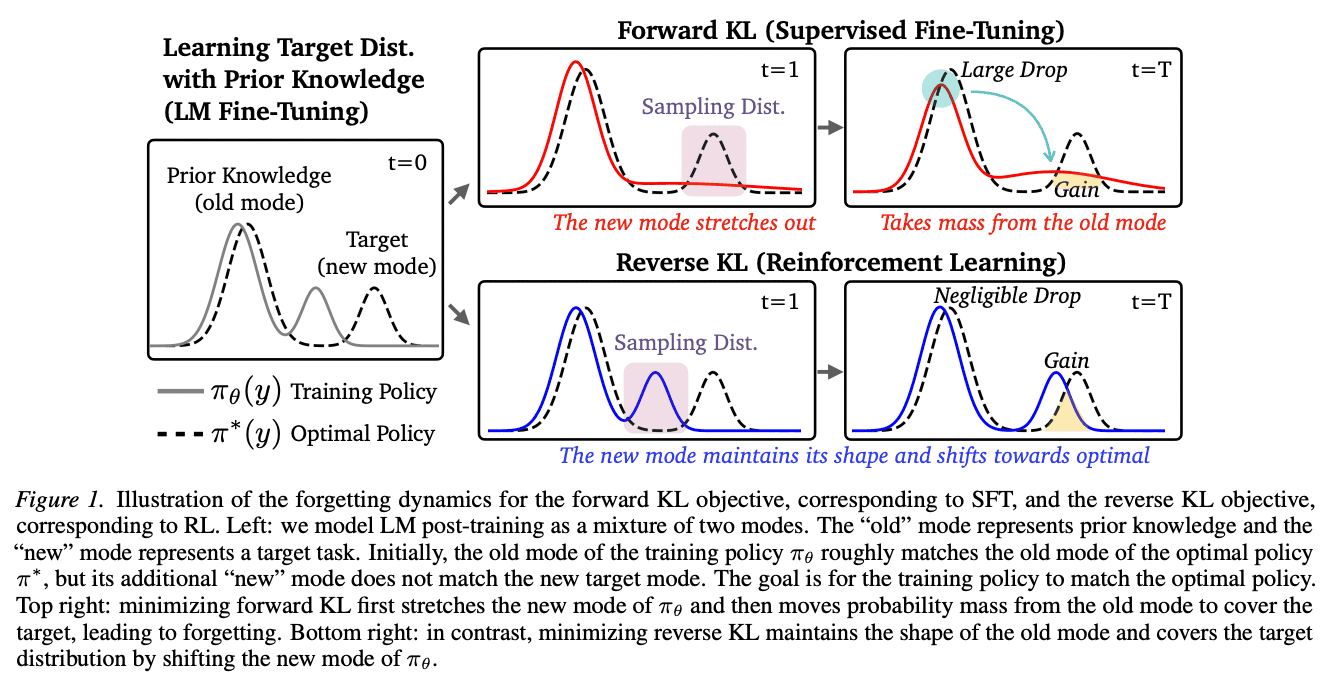 Chen et al. 2025
SFT/NLL minimizes forward KL divergence
In SFT, we have a labelled dataset representing the target distribution and try to make the model's distribution as similar to it as possible. The model is trained by minimizing the negative log likelihood:
which is the same as minimizing the forward KL divergence :
where the first term is the negative entropy of which doesn't depend on model parameters , and so the cross entropy term is what matters, and which is the same as the SFT loss.
It's called forward KL divergence by convention because the target distribution comes first and second. It asks:
When samples come from the target distribution how surprised is the model ?
You can see why forward KL/ SFT training is quite a violent technique in the sense that, no matter what the initial model distribution is, you will pull the model towards the target distribution. That's because any training example that has a high probability under the target distribution but a low probability under the model makes the SFT loss explode.
KL-regularized RL minimizes reverse KL divergence
That's different from the case of reverse KL divergence . By a similar derivation as above,
Unlike the target entropy in the forward-KL derivation, both terms depend on , so neither can be discarded. When , the second term further expands into the reference-policy and reward terms derived below.
We just swapped the order of the arguments, model distribution first, then target distribution, but the resulting loss function is quite different. This says:
Whatever you generate, make sure it lies in a high-probability region of p.
Note that training examples which the model never visits, i.e. where is low, don't contribute much to the overall loss. So the model is only judged on samples it generates, not all of what the target distribution prescribes.
In KL-regularized RL, the reference policy is typically a frozen copy of the model from before RL training. It anchors the learned policy, but it is not itself the reverse-KL target. Together with the reward, it defines the reward-tilted target distribution below. This frozen reference policy is also different from PPO's old policy , which is a periodically refreshed snapshot used to compute importance ratios during optimization.
Next let's look at why the (KL-regularized) RL loss is equivalent to reverse KL divergence. Let's start with the KL-regularized RL objective which is to maximize the expected reward subject to staying close to the reference policy:
where is the reward coming from a human in the case of RLHF or a verifier function in the case of RLVR. The term is what penalizes the model distribution for drifting too far away from the reference distribution (that's the KL-regularization).
Maximising the above is the same as minimising the negative objective:
And minimizing this loss is equivalent (up to a constant) to minimizing the reverse KL divergence :
where is a reward-tilted target distribution we can define as
with constant normalizer
Writing the quantity being maximized above as , the exact identity is
Because is constant with respect to , maximizing the reward while paying the KL penalty is the same objective as minimizing reverse KL toward .
So multiplying out the above, here is what we're left with in the end:
To sum up
- Maximizing the KL-regularized RL objective is equivalent to minimizing reverse KL divergence toward the reward-tilted target
- The entropy term can be thought of as a regularizer
- The cross-entropy term contributes to making the model less prone to catastrophic forgetting under RL than under SFT (allegedly, more on that later)
A reverse-KL variant of OPD
On-policy distillation is similar to SFT in that the model receives token-level feedback, rather than an overall training signal for the entire generation like in RL. In that sense parameter updates are more dense in OPD/SFT than in RL.
But it's also similar to RL in that we don't train on what the target distribution gives us but on what the model itself generates (on-policy). In OPD, we have a student policy, the model getting trained, and a teacher policy . We sample from the student and try to move the student closer to the teacher on those student-sampled outputs by minimising some loss. There is a lot of freedom in how we define the loss, e.g. it could be forward KL, reverse KL, or JSD[1].
If we choose to use reverse KL divergence, a useful sequence-level view of the objective is
which is exactly the definition of reverse KL over complete responses:
This sequence-level equation provides the intuition. GKD-style OPD[1] is trained at the token level, but let's keep the notation simple here.
So similar to the case of KL-regularized RL, we ask:
among the things the model generates, what should get reinforced/suppressed according to the teacher?
If the student assigns high probability to a token that the teacher considers unlikely, the reverse-KL loss is large and provides a training signal to reduce that token's probability.
Wrap up
In this article we reviewed how the training objectives differ in SFT, RL and OPD, from the perspective of whether they use forward or reverse KL divergence.
In SFT we're using forward KL divergence, which means that the expectation is under the target distribution . This forces the model to become more like the target distribution everywhere the target distribution assigns positive probability. In other words, we force the model to become the target distribution as much as possible. This makes SFT a very effective training method, but also risks catastrophic forgetting: by becoming more like the target distribution, the model forgets its own priors.
In RL/OPD, we often (but not necessarily) use reverse KL divergence which means the expectation is under the model's distribution . This means the loss is weighted by the policy, i.e. by the model's probability of generating a certain token. States that are never visited by the model don't contribute to the loss. The model is judged based on whether the target/teacher would have assigned high probability on those tokens too, but only if the model itself generates them. This allows the model to keep more of its prior knowledge when learning something new than in SFT, thereby reducing the risk of catastrophic forgetting.
Caveat: as Chen et al.[2] point out, RL is actually less prone to catastrophic forgetting than SFT even if we omit or scale down the KL-regularization, or if we use forward instead of reverse KL divergence. So while this all makes intuitive sense, maybe it's only part of the story ¯\_(ツ)_/¯
References
[1] R. Agarwal et al. On-Policy Distillation of Language Models: Learning from Self-Generated Mistakes, 2024.[paper]
[2] H. Chen et al. Retaining by Doing: The Role of On-Policy Data in Mitigating Forgetting, 2026.[paper]
[3] W. Hao. SFT, RL, and On-Policy Distillation Through a Distributional Lens, 2026.[blog]